







Site Prices Update
Last Updated28th June 2022
All calculations on this site are based on current fuel prices, they are checked regularly and calculations are automatically updated.
The costs calculated based on these fuel prices should be regarded as 'good estimates', given that fuel prices vary in different parts of the county and at different time of the year.
The calculations also have different levels of accuracy depending on the nature of the calculation. For example calculating the energy use of a known power output TV is very easy compared to calculating the effect on energy savings when insulating a cavity wall.
Site Calculations
Set Your Own Prices
User PricesFor several of the fuel prices on this site you can now set your own prices and all the calculations on the site will adjust accordingly.
Set Prices
At Confused About Energy we aim to provide practical, impartial advice on all aspects of energy usage, climate change and ways to save money on energy bills.
All calculations on this site are based on current fuel prices they are checked regularly are automatically updated and were last changed on:-
28th June 2022
The costs calculated based on these fuel prices should be regarded as 'good estimates', given that fuel prices vary in different parts of the county and at different time of the year.
The calculations also have different levels of accuracy depending on the nature of the calculation. For example calculating the energy use of a known power output TV is very easy compared to calculating the effect on energy savings when insulating a cavity wall.
Site Calculations
| Electricity | £0.271 per unit (1 kWh) |
| Economy Electricity | £0.094 per unit (1 kWh) |
| Gas | £0.072 per unit (1 kWh) |
| Domestic LPG | £0.122 per unit (1 kWh) |
| Heating Oil | £0.104 per unit (1 kWh) |
| UK Grid CO2 Emissions | 0.233 kg per kWh used |
The main units used in this site are in the table below, For a complete explanation of power and energy Read More.
| Unit | Name | Detail |
|---|---|---|
| W | Watt | Unit of Power |
| kW | Kilowatt | 1000 watts |
| kWh | Kilowatt hour | Measure of Energy |
| L | Litre | Measure of Volume |
Please use twitter to ask a question Message @@EnergyThinking
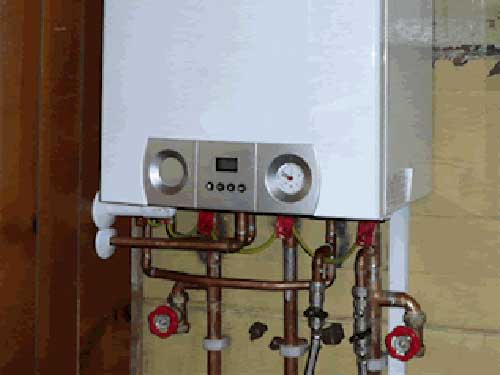
Generally central heating is the most energy and cost efficient way of heating a home, particularly those systems using fuels that are burned in a boiler. It is also very often one of those areas where you have the least control. Factors outside of your control may include:-
- Physical space to install equipment
- Local regulations (e.g. which fuels can you user?)
- Local infrastructure (e.g. do you have mains gas?)
- Do you own the property?
- Budget (do you have the cash to “upgrade”)
Regardless of these factors, this section aims to show the main general options to heat your home. For each one of the options presented there is also enormous choice available, for example, there are at least an unbelievable 4000 types of gas boiler on the market, with variations in brand, performance, and power output. The correct model for you will depend on you circumstances and a heating engineer will be more able to advise on this. You should do some research on the which boilers have the best reputation, this could save you a lot of headaches in the long run, do not just rely on the opinion of the installer, they may sell you junk.
There are two main groups of central heating systems, the more normal wet central heating and less common dry central heating :-
- Wet Central Heating:- A ‘wet’ systems is where a central boiler heats water which flows around radiators which can also be used to heat your water. Electricity, Oil, natural Gas, LPG, Coal or Wood can be used as fuels. There are regular boilers which heat water in a hot water cylinder and there are “combi” boilers which provide instantaneous hot water. For both of these you can now only buy condensing boilers, which are more energy efficient than their older counterparts.
- Dry Central Heating:- Less common are dry central heating systems such as ducted warm air, electrical element heating and electrical storage heaters. Both air ducting and electrical under floor are typically installed as a property is built or renovated, storage heaters can be installed at any time. Ducted warm air systems use a large furnace fuelled in a variety of ways to heat the air.
There are other large-scale heating systems heating systems which sit on the boundary between heaters and central heating, examples of these are large cooker/stove systems, ground source heat pumps, and air source heat pumps. These are covered in another article, please follow the links.
| Various Heaters |
| Heat pumps |
The tables below show the main "wet" central heating options, with the most common at the top and the more obscure lower down the table. Storage heater are also included for comparison. The table presents annual running costs for an older boiler, optimistically estimated at 70% efficient and a newer efficient probably fully condensing boiler, estimated at 90% efficient. It is very tricky to do a sensible comparison, so a typical 3 bed semi detached house has been considered and a heat output energy figure for both heating the house and the water for a full year has been taken to give a direct comparison to how much energy is consumed to deliver that heat and the cost of that energy. How much energy is actually consumed to deliver this heat output will depend on efficiency considerations of the boiler and the fuel used. Combi boilers and regular boilers are treated together in the table below, since in terms of energy use the only real difference is hot water and how this is generated and stored. The cost differences are relatively small.
To get a full cost comparison of the various units add the cost of the unit you are considering to the cost off the fuel option over the expected lifetime of the unit.
| Wet Systems Regular or Combi Boiler (Old Boiler estimated at 70% efficient) | Typical Annual running cost (3 bed semi), Assuming 16,000 kWh per year is output to heat the house or water | ||
|---|---|---|---|
| Old System 70% efficient | New system (condensing) 90% efficient | Notes | |
| Standard Electrical | £4817.778 (3728kg) (90%) |
£4564.211 (3728kg) (95%) |
|
| Natural Gas | £1645.714 (3360kg) |
£1280 (3360kg) |
|
| Heating Oil | £2377.143 (4800kg) |
£1848.889 (4800kg) |
|
| LPG | £2788.571 (3840kg) |
£2168.889 (3840kg) |
|
| Coal | £ 1142.857 | £ 888.889 | User login values do not work on this row yet. |
| Wood Pellets | £ 2148.571 | £ 1671.111 | User login values do not work on this row yet. |
| Wood Chips | £ 1142.857 | £ 888.889 | User login values do not work on this row yet. |
| Storage Heaters Economy Electrical Rate (not wet) | £1504 (3728kg) (100%) |
||
So important to upgrade heating systems for energy efficiency. Check out government grants, there's always something being given away whether it's a free boiler or insulation.
The email address at the foot of the page is confusedaboutenery.co.uk?My first vesit to the site but it looks like very usefull information.
oops thanks
i. Disappointment that only 12% of the table is completed. ii. There is no indication of the value for one of the most important factors in determining the cost of space heating: the temperature at which the space is to be maintained and for how long. Personally, I believe in sweaters but have not yet (two score years +) convinced my family. iii. Our 4-bedroom (1450 sq ft) home is a 1960 open plan, flat roof structure with a feature fireplace and a central stair well accommodates myself and my wife and a fairly steady stream of house guests. The heating is under-floor, off-peak electric with five separate area controls. There is no heating in place on the first floor, we do use an electric blanket. The off-peak electricity usage for the past four years has been: 10,352; 13,233;13,373; 12,487 kWh. The figure you allot for an average 3-bedroom house (in my George Wimpey days they were generally about 850 - 950 sq ft) is 16,000kWh. So it would appear that some miracle is being achieved. We intend moving to a three-bedroom bungalow and it would be useful to know how to transfer this miraculous environment. Can you help?
Yes must finish the table sorry.The 16,000KWh figure includes water heating also. I don't understand the miracle remark, it seems quite the opposite to me.


Comments and Questions